Bringing hypertension prevention, detection, and care closer to where people live and work
Meet Adjoa Mansa, a 52-year-old trader who spends most of her days at a busy market. She considers herself healthy and rarely visits a health facility unless she feels unwell.
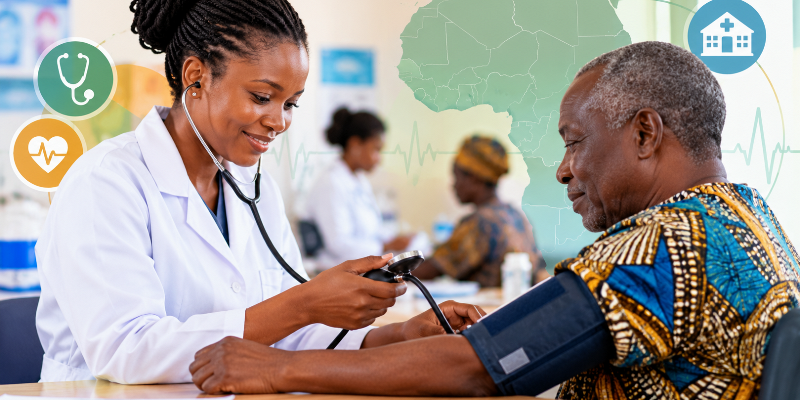
During a community health screening at the market, a nurse checks Adjoa’s blood pressure and finds that it is very high. She has never been diagnosed with hypertension and has no symptoms.
“I feel fine,” she says. “How can I have high blood pressure?”
She is referred to a nearby health centre, where a trained nurse prescriber confirms the diagnosis and initiates treatment.
Adjoa’s experience reflects a wider challenge across Africa. Hypertension can remain undiagnosed and uncontrolled for years, silently increasing the risk of stroke, heart disease and kidney disease.
What do the new hypertension guidelines mean for Africa?
The 2026 International Society of Hypertension (ISH) Guidelines for the Management of Hypertension in Africa, developed with the Pan-African Society of Cardiology (PASCAR), provide a framework designed around the realities of African health systems.
These realities include shortages of physicians, constrained health financing, and limited access to diagnostic services and essential medicines. Rather than relying solely on specialist or hospital-based care, the guidelines place primary healthcare at the centre of hypertension prevention, detection and management.
Bringing hypertension care closer to communities
One important message from the guidelines is that hypertension care should not be limited to hospitals or doctors.
Through task sharing, appropriately trained and supervised nurses, physician assistants, pharmacists and other non-physician health workers can contribute to detecting and managing hypertension.
This approach can bring care closer to communities and potentially reduce some of the barriers people face in accessing hypertension services.
Finding hypertension before complications develop
Hypertension is particularly challenging because people may have dangerously high blood pressure without experiencing symptoms as Adjoa’s story illustrates.
The guidelines therefore encourage screening beyond traditional healthcare settings. Blood pressure checks can take place in markets, workplaces, schools, pharmacies, religious centres, hair salons, barbershops and other community spaces, with people who have raised blood pressure linked to health facilities for confirmation and appropriate management.
This approach creates opportunities to identify people earlier before hypertension leads to serious complications.
Hypertension rarely exists alone
For the M-CARE Project, an especially relevant aspect of the guidelines is the recognition that hypertension often coexists with other long-term health conditions.
A person living with hypertension may also have diabetes, chronic kidney disease or other conditions. The guidelines also highlight opportunities to integrate hypertension screening and care into existing health programmes, including HIV services.
Mental health is also important. Stress, anxiety and depression can affect how people manage hypertension. Counselling, patient education and psychosocial assessment therefore have an important place in comprehensive care.
Why this matters for M-CARE
This closely aligns with a central principle of M-CARE: people do not experience diseases as separate programmes.
Someone attending a primary healthcare facility may be living with hypertension, diabetes and a mental health condition at the same time. Managing only one condition while overlooking the others can result in fragmented care.
M-CARE is working across Ghana, Kenya and Uganda to strengthen approaches to integrated care for people living with multiple cardiometabolic and mental health conditions. Primary healthcare provides an important platform for bringing these different aspects of care together and placing the person not an individual disease at the centre of care.
From guidelines to stronger health systems
Publishing guidelines is an important step, but their impact ultimately depends on implementation.
For the recommendations to translate into better care, primary healthcare systems need functional blood pressure devices, appropriately trained health workers, affordable medicines, effective referral pathways and reliable follow-up systems. Digital technologies may also support patient education, monitoring and treatment adherence.
For Adjoa, this approach means more than discovering that her blood pressure is high. It means receiving timely treatment and follow-up while also being assessed for other conditions that may affect her overall health.
Looking ahead
The new guidelines reinforce an important message for hypertension care in Africa: care needs to begin early, reach people where they are, and address the whole person rather than only the numbers on a blood pressure monitor.
Strengthening primary healthcare, expanding community-based detection, supporting task sharing and integrating the management of related physical and mental health conditions could help move health systems towards more accessible, coordinated and person-centred care.
For M-CARE, this is particularly relevant as we continue working with health professionals, policymakers, researchers and communities to understand how integrated care can be implemented effectively within real-world primary healthcare systems.
Better hypertension care is not only about lowering blood pressure—it is about building primary healthcare systems that can respond to the whole person.
For more information about M-CARE, our research, activities and latest updates, visit the M-CARE website and follow us on our social media platforms.
Read the full 2026 ISH Guidelines for the Management of Hypertension in Africa: https://doi.org/10.1097/hjh.0000000000004411
#MCARE #Hypertension #PrimaryCare #IntegratedCare #Multimorbidity #CardiometabolicHealth #MentalHealth #NCDs #ImplementationScience #HealthSystems #GlobalHealth